
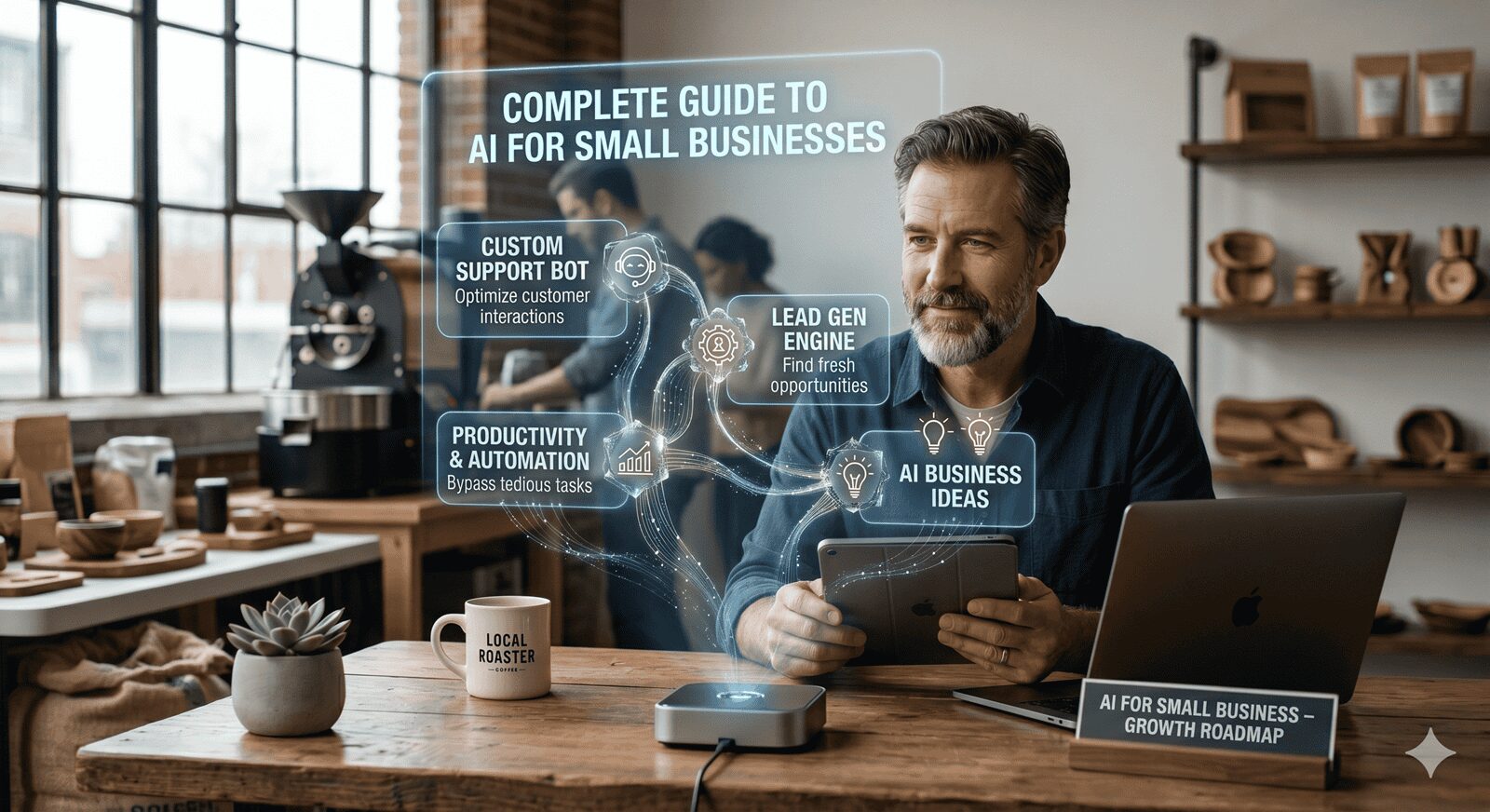
The Complete Guide to AI for Small Businesses: Transforming Operations in 2026
If you are running a small business today, you already know that time is your most precious, unrenewable resource. Between managing client expectations, balancing the books, putting out daily operational fires, and trying to find a spare moment for strategic growth, it often feels like there are simply not enough hours in the week. Enter Artificial Intelligence. A few years ago, AI was a buzzword thrown around by Silicon Valley startups with massive budgets. Today, the landscape has entirely shifted. AI has been democratized, scaled down, and packaged into accessible, affordable tools specifically designed for the main street entrepreneur, the solo founder, and the growing agency.
The conversation in 2026 is no longer about if you should use AI, but how quickly you can integrate it to avoid falling behind your competitors. Small businesses are utilizing AI not to replace their human workforce, but to give their existing teams superhuman leverage. Whether it is answering routine customer inquiries at 2:00 AM, sorting through thousands of leads to find the warm prospects, or automating the mind-numbing administrative tasks that eat up your afternoons, AI is the silent business partner you never knew you needed.
In this comprehensive guide, we are going to tear down the jargon and look at exactly how you can implement AI in your business right now. We will explore the best AI tools for small businesses, dive deep into customer support and lead generation, unpack how to build automated workflows, and even look at brand new AI business ideas you can launch this year. Grab a cup of coffee, and let’s build your AI roadmap.
1. The Best AI Tools for Small Businesses
The sheer volume of AI tools launching every week can cause severe analysis paralysis. You do not need fifty different subscriptions to be an AI-powered business; you just need a core stack of reliable, secure, and highly functional platforms. Here are the absolute best AI tools every small business should consider integrating into their operations.
ChatGPT (OpenAI) and Claude (Anthropic): The Ultimate Co-Pilots
If you only adopt one AI tool, make it a sophisticated Large Language Model (LLM) like ChatGPT or Claude. Think of these tools as your eager, incredibly fast executive assistants. ChatGPT is phenomenal for brainstorming marketing campaigns, writing first drafts of blog posts, translating complex legal jargon into plain English, and analyzing spreadsheets of customer data. Claude, on the other hand, excels at nuance, safe data handling, and maintaining a highly natural, conversational tone for long-form writing. Both platforms allow you to create “Custom GPTs” or “Projects” where you can upload your specific brand guidelines, ensuring the AI writes in your exact voice.
Notion AI: The Intelligent Workspace
Notion has long been a favorite for organizing company wikis, Standard Operating Procedures (SOPs), and project boards. With Notion AI integrated directly into the workspace, it becomes a “company brain.” If you have a massive document of meeting notes, Notion AI can instantly extract the action items and assign them to team members. It helps you draft documents, summarize chaotic brainstorming sessions, and keeps your internal knowledge base entirely searchable and actionable.
Canva Magic Studio: The Democratization of Design
Visual branding is critical, but hiring a full-time graphic designer isn’t always in the budget for a small business. Canva’s AI-powered Magic Studio allows anyone to create stunning, professional assets. You can type a text prompt like “Create a modern Instagram carousel about summer plumbing maintenance,” and Canva will generate the layouts, copy, and images. Features like Magic Expand (which extends the borders of an image) and Magic Eraser (which removes photobombers or unwanted objects) save hours of tedious photo editing.
Jasper: The Conversion-Focused Marketer
While ChatGPT is a generalist, Jasper is trained specifically on high-converting marketing copy. If your primary bottleneck is writing product descriptions that sell, Facebook ad copy that clicks, or email newsletters that get opened, Jasper is your tool. It understands copywriting frameworks (like AIDA—Attention, Interest, Desire, Action) and helps maintain a consistent, persuasive brand voice across all your marketing channels.
Grammarly Business: The Brand Protector
Nothing destroys credibility faster than a sloppy, typo-ridden proposal sent to a high-value client. Grammarly has evolved far beyond a simple spell-checker. The AI analyzes the tone of your emails to ensure you don’t sound unintentionally aggressive, adjusts the clarity of your sentences, and ensures compliance with your company’s style guide. It works silently in the background across your browser, email client, and document editors.
2. AI Customer Support: Building Relationships at Scale
For years, the phrase “customer support chatbot” sent shivers down the spines of consumers. We all remember the frustrating loops of “I didn’t quite catch that” from early bots that simply tried to deflect customers away from human agents. In 2026, AI customer support has undergone a total revolution. It is no longer about deflection; it is about instant, personalized resolution.
Small businesses are competing against giants like Amazon, who have trained consumers to expect immediate answers and lightning-fast resolutions. You may not have a 50-person support center operating 24/7, but with AI, you can provide the exact same level of service. Tools like Gladly, Tidio, and Zendesk AI connect directly to your knowledge base, your product inventory, and your shipping software. When a customer asks, “Where is my order?”, the AI doesn’t just link them to a generic FAQ page. It looks up their email address, pings your shipping provider, and responds conversationally: “Hi Sarah! Your package containing the blue ceramic mug was scanned in Chicago this morning and should arrive by tomorrow afternoon.”
Furthermore, AI empowers your human agents. When an issue is too complex or emotionally sensitive for an AI to handle, it seamlessly routes the conversation to a human. Before the human agent even types “Hello,” the AI provides a bulleted summary of the customer’s entire history, their current frustration, and a suggested solution. This drops resolution times drastically and turns angry customers into loyal brand advocates because they feel truly heard and understood, without having to repeat their problem three times.
3. AI Lead Generation: The Era of Signal-Based Selling
Historically, B2B lead generation was a numbers game. Sales reps would buy a massive list of thousands of emails, load them into a sequencing tool, blast out generic pitches, and pray for a 1% conversion rate. This “spray and pray” method is dead. Buyers are exhausted by automated spam, and email service providers will aggressively block domains that exhibit this behavior. The new frontier is AI-driven, signal-based selling.
AI lead generation tools like Clay, Apollo.io, and Amplemarket allow small businesses to prospect with surgical precision. Instead of searching for “Marketing Managers in Texas,” AI allows you to search for intent signals. You can tell the AI: “Find me marketing managers in the logistics industry who have recently hired a new SEO specialist, whose company just announced a new funding round, and who have interacted with our competitors on LinkedIn.”
Once the AI identifies these hyper-qualified leads, the real magic happens in the outreach. AI tools can analyze the prospect’s recent LinkedIn posts, company news, and podcast appearances to draft a highly personalized, one-to-one email that proves you have actually done your research. By combining deep data enrichment with AI-generated personalization, small businesses are seeing their open rates and reply rates skyrocket. You are no longer bothering people; you are arriving with a tailored solution at the exact moment they are experiencing a problem.
4. AI Productivity: Doing More with Less
Productivity is not about working longer hours; it is about working on the right things. The average small business owner spends over 40% of their week on administrative tasks—managing scheduling, summarizing meetings, organizing files, and staring at a blank screen trying to write an update. AI gives you that time back.
Consider the meeting ecosystem. Tools like Fireflies.ai, Otter.ai, or Fathom join your Zoom or Google Meet calls as silent participants. They provide a flawless transcription of the conversation, but more importantly, they use AI to summarize the meeting. Within two minutes of hanging up, you receive an email containing a brief executive summary, the key decisions made, and a bulleted list of action items assigned to specific people. No more frantic note-taking while trying to actively listen to a client.
For daily operational tasks, native integrations are changing the game. Microsoft 365 Copilot and Google Workspace Gemini embed AI directly into the tools you already use. You can open a blank presentation in PowerPoint and ask Copilot to “Create a 10-slide pitch deck based on the Q3 financial report document,” and it will generate the slides, charts, and talking points in seconds. You can ask your email client to “Summarize the thread from the accounting team,” saving you from reading twenty back-and-forth replies. These micro-efficiencies compound daily, allowing small teams to output the work of departments twice their size.
5. AI Automation: The Engine of Scalability
While productivity tools make human tasks faster, AI automation removes the human from the task entirely. The bridge connecting your disconnected software applications is Zapier. Zapier has long been the king of webhooks and API connections, but with their new AI agent builders, automation has become intelligent.
Imagine a common small business scenario: A new lead fills out a form on your website. Without automation, someone has to read the email, manually enter the data into a CRM, assign a salesperson, and remember to send a follow-up email. With AI automation, the moment that form is submitted, a workflow is triggered. The AI analyzes the lead’s company size to determine if they are a high-tier or low-tier prospect. If they are high-tier, the AI automatically creates a record in HubSpot, sends an alert to the senior sales rep via Slack with a summary of the lead’s website, and drafts a personalized introductory email that sits in the rep’s drafts folder waiting for approval. If they are a low-tier prospect, the AI automatically drops them into a pre-written email nurture sequence. All of this happens in three seconds, while you are sleeping.
Another massive area for automation is financial operations. Small businesses can set up workflows where invoices emailed by vendors are automatically scanned by AI. The AI extracts the vendor name, the total amount, the line items, and the due date, and injects that data directly into QuickBooks or Xero, attaching the original PDF for compliance. By automating data entry, lead routing, and document processing, your business becomes a scalable machine that can handle 10x the volume without requiring 10x the headcount.
6. AI Business Ideas: New Frontiers for Entrepreneurs
The AI boom hasn’t just improved existing businesses; it has created entirely new categories of entrepreneurship. If you are looking to start a new venture in 2026, AI lowers the barrier to entry significantly. Here are a few high-potential AI business ideas designed for solo operators and small teams.
1. Niche AI Consulting & Setup Agency: Every local business—from the corner dental practice to the regional plumbing company—knows they need AI, but they are terrified of the technology. You can build a highly lucrative agency simply by auditing local businesses and setting up basic AI tools for them. You charge a setup fee to implement an AI customer service chatbot, automate their lead flow into a CRM, and train their staff on ChatGPT. You are selling efficiency and modernization.
2. Programmatic SEO and Content Empires: By combining data extraction tools with AI writers, you can build massive, hyper-targeted niche websites. Instead of writing one article about “Best Coffee Shops,” you can programmatically generate thousands of high-quality pages detailing the best coffee shops in every specific zip code, monetizing the traffic through AdSense or local lead generation. When done correctly, maintaining strict quality control, this creates incredibly passive revenue streams.
3. Automated Bookkeeping and Financial Analysis: If you have an accounting background, AI allows you to service ten times the number of clients. By utilizing AI tools to ingest, categorize, and reconcile expenses automatically, your business transitions from doing the raw math to providing high-level financial advisory. You package your services as a “fractional AI CFO” for other small businesses.
4. AI-Powered Personalized Newsletters: Content curation is highly valuable. You can build automation scripts that scrape the web for industry-specific news (e.g., “The latest in commercial real estate law”), feed the raw data to an LLM to summarize and format it into an engaging tone, and automatically dispatch it via tools like Mailchimp or Beehiiv. You monetize through sponsorships and premium subscriptions, running a media company with zero staff writers.
Choosing the Right AI Tools for Your Small Business
With so much potential, the biggest mistake small business owners make is trying to implement everything at once. This leads to “software fatigue,” skyrocketing subscription costs, and a confused team that reverts back to doing things the old manual way. Implementation requires a strategic, phased approach.
Start by auditing your bottlenecks. Spend one week writing down every task that frustrates you, takes too long, or requires tedious data entry. Look for the highest point of friction. Is your inbox overflowing with customer questions? Start with an AI support tool. Are your sales reps struggling to find good leads? Invest in an AI lead generation platform. Choose exactly one problem to solve, and pick one tool to solve it. Spend a month mastering that specific workflow and training your team on the new SOP. Once that AI process is running smoothly and quietly in the background, move on to the next bottleneck. Growth is achieved through disciplined, incremental improvements.
Conclusion
Artificial Intelligence is not a passing trend; it is the fundamental infrastructure of the future small business economy. The companies that thrive over the next decade will be the ones that view AI not as an intimidating robot looking to take jobs, but as a tireless, brilliant collaborator. By leveraging AI for customer support, lead generation, productivity, and automation, you are fundamentally changing the math of your business. You are lowering your operational costs, increasing your output quality, and most importantly, buying back the time you need to focus on what humans do best: strategy, empathy, and genuine relationship building. The tools are ready, the barrier to entry has never been lower, and the time to start building your AI-powered small business is right now.
Frequently Asked Questions (FAQs)
1. Is AI too expensive for a small business on a tight budget?
Not at all. In fact, AI is incredibly cost-effective. Many of the most powerful tools, like ChatGPT, Claude, and Canva, offer robust free tiers or start at around $20 per month. When you compare a $20 monthly subscription to the cost of hiring a virtual assistant or a freelance writer, AI provides an astonishingly high return on investment. The key is to avoid stacking dozens of subscriptions and instead rely on versatile, foundational tools.
2. Will implementing AI replace my current employees?
AI is designed to replace tasks, not people. The goal of AI in a small business is to eliminate the repetitive, monotonous work—like data entry, basic scheduling, and first-draft writing—so your employees can focus on high-level, creative, and strategic tasks. Teams equipped with AI report higher job satisfaction because they are freed from the “busywork” that leads to burnout.
3. Is it safe to put my company and customer data into AI tools?
Data security is a vital concern. When using public, free versions of LLMs, your data may be used to train future models. However, when you use enterprise or paid tiers (like ChatGPT Team/Enterprise or Microsoft Copilot), providers explicitly state that your data remains private and is not used for training. Always review the privacy policy of any tool before uploading sensitive client data, and opt out of data-sharing features whenever possible.
4. How do I make AI-generated content sound like my brand instead of a robot?
The secret to great AI content is the quality of your prompt and the context you provide. Do not just ask AI to “write a blog post.” Provide it with examples of your past writing, explicitly state your brand values, define your target audience, and give it a specific tone (e.g., “warm, professional, and slightly humorous”). Use the AI to generate the first draft, and then have a human editor refine the text to ensure it perfectly captures your unique voice.
5. I am not technically savvy. Where is the best place to start?
The best place to start is with everyday productivity. Sign up for a free ChatGPT account and keep it open in a tab on your browser. For the next week, whenever you are stuck writing a difficult email, trying to summarize a long article, or brainstorming ideas for a social media post, ask the AI for help. By simply interacting with it daily, you will naturally discover how it can speed up your specific workflows without needing any coding or technical skills.
COMMENTS