
CAGR Calculator
What is a CAGR Calculator and Why Do You Need It?
If you have ever invested your hard-earned money in mutual funds, stocks, real estate, or even fixed deposits, you have likely wondered exactly how much your money has grown over time. While looking at the absolute profit is exciting, it does not give you the full picture, especially when your investment spans several years. This is where a CAGR Calculator becomes an indispensable financial tool. CAGR, or Compound Annual Growth Rate, is the gold standard for measuring the performance of an investment over multiple time periods. It smooths out the volatility and gives you a single, annualized percentage that represents your investment's growth.
Using our highly accurate CAGR Calculator, you can instantly determine the rate at which your initial investment would have grown if it had compounded at a steady rate every year. Whether you are a seasoned investor analyzing a complex portfolio or a beginner trying to understand the returns on a simple savings scheme, calculating the Compound Annual Growth Rate takes the guesswork out of financial planning. It allows you to make apples-to-apples comparisons between completely different asset classes.
Understanding the Concept: What Exactly is CAGR?
The Compound Annual Growth Rate (CAGR) is a mathematical formula that provides a smoothed rate of return. Markets are inherently volatile; a stock might go up 20% one year, drop 10% the next, and rise 15% the year after. If you try to calculate the simple average of these numbers, you will get a distorted view of your actual wealth creation. CAGR ignores the chaotic journey your investment took and instead draws a straight, smooth line from your starting balance to your ending balance.
Imagine you planted a tree. In the first year, it grows rapidly because of heavy rains. In the second year, there is a drought, and it barely grows. In the third year, growth is moderate. If you want to tell a friend how fast your tree grows on average per year, you wouldn't list out the yearly statistics; you would give them an annualized average rate. That is exactly what CAGR does for your money. It assumes that your investment grew at a steady, compounded rate every single year to reach its final value.
The Mathematics: How to Calculate CAGR
While our CAGR Calculator handles the heavy lifting for you instantly, it is highly beneficial for any serious investor to understand the underlying mathematics. The formula for Compound Annual Growth Rate is globally recognized and used by top financial analysts.
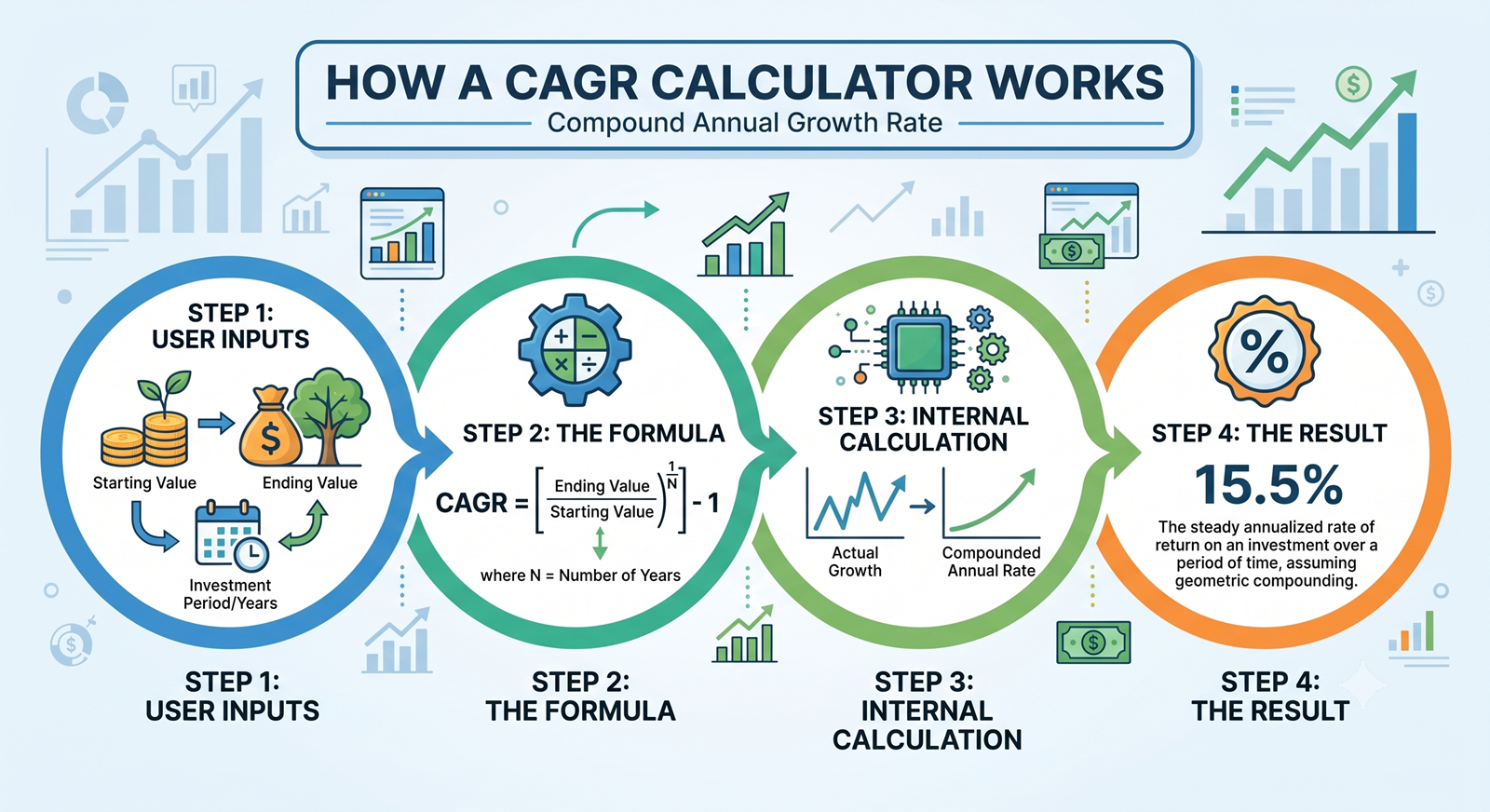
The CAGR Formula is:
CAGR = [(Final Value / Initial Value) ^ (1 / Number of Years)] - 1
Breaking Down the Formula Variables
- Initial Value: This is the starting amount of your investment. It is the principal sum you put into the asset at the beginning of the time period.
- Final Value: This is the current or ending value of your investment at the close of the period you are measuring.
- Number of Years (Tenure): This is the total time your money was invested, expressed in years. If you invested for 30 months, this would be 2.5 years.
Step-by-Step Guide: How to Use Our CAGR Calculator
We have designed our CAGR Calculator to be incredibly user-friendly, requiring zero technical or financial background to operate. Follow these simple steps to find your investment's growth rate:
- Enter the Initial Investment: Input the exact amount of money you started with. For example, if you bought mutual fund units worth ₹1,00,000, enter that figure here.
- Enter the Final Value: Look at your current portfolio statement and enter the present value of that specific investment. Let's say it is now worth ₹1,50,000.
- Input the Duration: Enter the number of years between the initial investment date and today. For partial years, use decimals (e.g., 3.5 for three and a half years).
- Click Calculate: Hit the button, and the CAGR Calculator will instantly display your annualized percentage return as well as the absolute monetary growth of your investment.
CAGR vs. Other Financial Metrics
To become a truly informed investor, you must understand why a CAGR calculator is preferred over other methods of calculating returns, and when it might not be the best choice. Let's compare CAGR to other popular financial metrics.
1. CAGR vs. Absolute Return
Absolute return is the simplest way to measure growth. It is just the total percentage gained or lost, regardless of time. If you invest ₹1,00,000 and it becomes ₹2,00,000, your absolute return is 100%. However, absolute return is dangerously misleading because it ignores time. A 100% return over 2 years is phenomenal, but a 100% return over 20 years is actually quite poor, barely keeping up with inflation. A CAGR calculator factors in time, giving you a true measure of performance.
2. CAGR vs. XIRR (Extended Internal Rate of Return)
This is a crucial distinction. A CAGR Calculator is perfect for point-to-point investments—meaning you put a lump sum in on Day 1, and you take it out on Day 1000, with no transactions in between. However, if you are doing a Systematic Investment Plan (SIP) where you invest money every month, CAGR will not work correctly. For multiple cash inflows and outflows at different times, you must use XIRR. XIRR applies the concept of CAGR to every individual transaction based on the exact number of days that specific amount was invested.
3. CAGR vs. Average Annual Return
Average annual return simply adds up the returns of each year and divides by the number of years. This ignores the effects of compounding and can give a false sense of security. For instance, if a stock gains 100% in year one (₹100 to ₹200) and loses 50% in year two (₹200 back to ₹100), the average annual return is 25% ((100-50)/2). But your actual money has not grown at all; you are back to where you started. A CAGR calculator correctly identifies this scenario as a 0% return.
Real-World Applications: Where to Use a CAGR Calculator
The beauty of the Compound Annual Growth Rate is its versatility. You can use it across almost every aspect of finance and business. Here are the most common ways our users leverage this metric:
Evaluating Mutual Fund Performance
When you look at mutual fund fact sheets, the historical returns (1-year, 3-year, 5-year, and 10-year) are always displayed as CAGR. By using a CAGR Calculator, you can verify these numbers yourself or calculate the return for a custom date range that matches your exact holding period, helping you decide whether to hold or sell the fund.
Real Estate Investment Analysis
Real estate is highly illiquid and usually held for decades. If you bought a property for ₹50,00,000 in 2010 and sold it for ₹1,50,00,000 in 2024, the absolute return looks massive. But when you plug those numbers and the 14-year duration into a CAGR Calculator, you can compare the annualized property appreciation against what you might have earned in a simple index fund or fixed deposit, factoring in inflation.
Business and Corporate Growth
Entrepreneurs and corporate executives frequently use CAGR to measure business metrics beyond just investments. You can calculate the CAGR of your company's revenue, net profit, customer acquisition, or market share over a five-year strategic period. It provides a clear metric to present to investors and board members to demonstrate sustainable business growth.
The Limitations of CAGR: What It Doesn't Tell You
While a CAGR Calculator is a powerful tool, it is equally important to understand its blind spots. No single financial metric is perfect, and relying solely on CAGR without looking at the broader context can lead to poor financial decisions.
1. It Hides Volatility: Because CAGR smooths out returns, it creates an illusion of a steady, risk-free climb. Two investments can have the exact same 10% CAGR over five years, but one might have achieved it with slow, steady growth, while the other experienced terrifying 40% market crashes and massive spikes. CAGR tells you the destination, but it hides how bumpy the ride was.
2. It Ignores Intermediate Cash Flows: As mentioned earlier with XIRR, standard CAGR assumes you made a single lump-sum investment and never touched it again. If you deposited more money or withdrew funds during the investment period, a standard CAGR calculator will give you an incorrect growth rate.
3. It is Not a Predictor of the Future: Just because a mutual fund has a historical 10-year CAGR of 15% does not mean it will generate 15% next year. CAGR is strictly a historical metric. The market environment, interest rates, and economic cycles constantly change, and past performance is never a guarantee of future results.
The Power of Compounding: The Engine Behind CAGR
To truly appreciate what a CAGR Calculator reveals, you must understand the "Eighth Wonder of the World"—Compound Interest. When your money grows, it generates returns. In the next year, those returns generate their own returns. Over long periods, this snowball effect causes exponential wealth creation.
For example, an investment growing at a 12% CAGR will double in value approximately every 6 years. By year 12, it has quadrupled. By year 24, it has multiplied by 16 times! This is why financial advisors constantly preach the importance of starting early. Even a small increase in your CAGR (e.g., improving from an 8% return to a 10% return) can result in a massive difference in your final corpus over a 20 or 30-year investment horizon.
Conclusion: Empower Your Financial Decisions
In the modern landscape of personal finance, relying on gut feelings or basic absolute returns is a recipe for mediocrity. By making a habit of using a CAGR Calculator, you bring mathematical clarity to your portfolio. You can ruthlessly cut underperforming assets, realistically plan for your retirement, and understand the true pace at which your wealth is expanding. Bookmark this tool, use it before making major investment shifts, and take control of your financial destiny.